Showing posts with label International Trade. Show all posts

Thursday, February 12, 2015

An international flowering of trade

Alex Tabarrok's Valentine's Day video is a take-off of Leonard Read's "I, Pencil" and a great lesson on spontaneous order around meeting human needs.


Read more...

Tuesday, July 8, 2014

The buzz on Converse fuzz

Here's a good economics lesson: Why do the popular Converse shoes come with a fuzzy layer on the bottom that is soon rubbed off through normal wear and offers no physical benefit or utility?

A few years ago someone at a party told me he works at Converse, makers of the popular canvas shoe and said it's there to dodge a tariff.

Converse sneakers are like Pabst Blue Ribbon beer: They developed a cult following because they were cheap and stylish, but after capturing a big market share and gaining customer loyalty, they pushed the brand further and raised prices, but managed to hold on to customers.

Even with that popularity the company has an incentive to save money wherever it can to maximize profits, and the purpose of the fuzzy layer is to save money.

Under American trade law, Chinese-made sneakers incur an import tariff of 37.5 percent. However, slippers have a much lower 3 percent tariff and the fuzzy layer makes the shoes count as slippers, despite everyone knowing full well that they are outdoor shoes.

A friend at that party asked that since Converse is so profitable why doesn't it just pay the full tariff. The answer is they've found a simple way to avoid it, so they have no reason to pay it.
Read more...

Wednesday, April 23, 2014

Frozen trade policy blunder

I'm fully aware of how incredibly nerdy it is too pick apart a small, semi-obscure detail in a movie - in this case an animated Disney movie - but I just saw Frozen and something didn't sit right with me.

The queen hurt a lot of innocent people - including her own - to get back at one minor villain.

The introduction for the Duke of Weselton showed him plotting to open up trade with the Kingdom of n Arendelle, which would somehow exploit Arendelle and make Wezelton richer - which is nonsensical, but minor.

What's much more troubling is that after the Duke is found to have tried to kill the queen, she punishes him by cutting off all trade.

Don Boudreaux compared punitive trade restrictions to fighting a war by shooting ones own citizens. What the queen did was make the citizens of Wezelton poorer, as well as make the citizens of her own kingdom poorer as well. She hurt a lot of people to get back at one guy. That's cold.

Read more...

Saturday, December 14, 2013

I, Nutella

That simple spread of hazelnut and cocoa that everyone loves has a cross-continental pedigree, as emphasized in a recent report by the Organisation for Economic Co-operation and Development.

Nutella combines vanilla flavoring from France, hazelnuts from Turkey, palm oil from Malaysia, sugar from Brazil and cocoa from Nigeria. The OECD used it as an example in a recent report to demonstrate global supply chains and it's gathered a lot of attention.

Nutella would not be possible without globalization. Like a famous essay said about the pencil, each jar contains the labor of thousands of people across the globe. There's no single location on earth that could ever make it without outside help.

Unlike other foods with a lot of ingredients, such as sour cream and salsa pork rinds, Nutella has a highborn reputation. It's artsy to like Nutella. The spread is borderline pretentious. That's very different from the low-status products that are usually associated with globalization like McDonald's food.

Globalization needs a new symbol that can engage people, and Nutella is a perfect choice. Globalization simply means the extension of human cooperation over international lines, instead of restricting it to the immediate area. Violent mobs and fringe speakers have given the word an unpleasant edge to the general public and not enough people name "globalization" as something they support.

Only a gullible fool would balk at spreading delicious Nutella across their bread. Nutella is the beautiful child of international cooperation, and people need to appreciate and understand that origin along with its captivating taste.
Read more...

Monday, November 25, 2013

Bogus trade arguments are often made in America

Once again I am compelled to remind people that good graphics and snazzy background music are no substitute for proper academic research.

Someone sent Mike Munger a video entitle "Million American Jobs Project" that rehashes the old protectionist get-rich scheme of diverting consumer spending to domestic products while ignoring higher costs and the wealth destruction that follows.


The entire thing appears to be a rip off of ABC's Made in America political campaign from a few years ago, right down to the bogus claim that unnamed economists back up what they're saying.

If each of us spends just 5 percent more on things made in America, economists say we will create a minimum of a million new jobs for Americans.
That's a lie. You're a liar, Mr. nice sweater with rolled-up sleeves to express you devotion to hard work. Your "research" was also a complete farce, as American manufacturing jobs didn't leave so much as get replaced by labor-saving technologies. That's why production levels rose as employment levels fell.
Read more...

Friday, September 6, 2013

September is smarter than the smarties

This month has a lot to offer.

Next week Ducktales: Remastered comes out for the Xbox 360.

In the week after that, Grand Theft Auto V hits the shelves.

And now to cap it off Marginal Revolution University is releasing a free six-hour course on international trade.

I'm taking the day off work for the first two. I might have to consider taking a third one off for Mr. University.


Read more...

Monday, April 15, 2013

Anti-globalization dishonesty

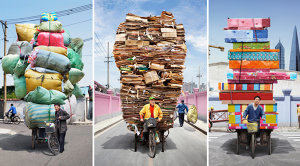
I was recently lured into viewing an article on a series of photographs French artist Alain Delorme compiled that turned out to be bogus.

The article was titled "Look At These Chinese Workers Carrying Mind-Blowing Amounts Of Stuff" but it turned out the images were all fakes created in photoshop.

From an NPR interview on his website:

Turns out, Paris-based Delorme creates these spectacular towers of boxes, tires and blankets using Photoshop. As he exaggerates reality by meticulously stitching together the image, he tries to confuse the line between what is fake and what is real, and raise questions around the limits and rules of documentary photography. 
"Even pictures covering a story are retouched to look cleaner, more beautiful," he writes in an e-mail. "What are the limits when the search for perfect aesthetics hides a part of reality?"

So he thinks what he's doing is acceptable because other people adjust the lighting in their photos. Here's what he said his intention is with the series in the new piece:

Delorme alters the photos with Photoshop to exaggerate the loads his subjects carry and heighten that sense of consumption. "To what extent can we play with reality to get the viewer to ask questions?" He says the works investigate globalization and consumerism. "But it is above all a way to make people think about the consumer society we live in via the ‘Made in China’ phenomenon, with all its identical and exchangeable objects produced in big quantities."

Why is it critics of globalization avoid coming out and saying what they mean? Globalization is the extension of human cooperation across international borders and protectionists like Delorme rarely say they oppose it, but claim their propaganda makes people "think" about the issue or study it.

Bottom line, when you have to lie to people to make your point the way Delorme did with his fake images you are admitting your case is weak.

Read more...

Tuesday, February 19, 2013

Choose Canadian

Look out, American localists, the Canadians want to play too and they aim to stop your precious exports. Man the nationalist battlestations!


The entire message is a tossed salad of lies. The most amusing one is its use of "we" instead of "you" when referring to Canadians, as Hellmann's mayonnaise is owned by UK-based Unilever.

I wonder if actual people with actual blood pumping into their brains think it's a problem that icy Canada imports most of its fruit.

If the audacity of this localwashing wasn't enough for you, look at the sneaky fine print at the bottom of the official page:

This website is directed only to Canadian consumers for products and services of Unilever Canada. This website is not directed to US consumers or any other consumer outside Canada.

Do not pay attention to the man behind the curtain, American consumers. Keep buying local and ignore our advice to Canadians to break off commerce with your producers.

Read more...

Sunday, February 3, 2013

Buy Local myths at Skepticamp

My talk from last October at the New Hampshire Skepticamp event is now online.


Read more...

Saturday, January 26, 2013

Protectionism and the hierarchy of needs

International trade is one of those subjects that people talk about with confidence when they really don't understand the basics. It seems like common sense. Of course we want to be the ones who produce cheap merchandise. Of course China is doing all of our manufacturing for us, as we can clearly demonstrate by looking at where cheap consumer goods are made. Of course the purpose of free trade is to increase our exports.

All three of those common sense ideas are wrong and they require looking at international trade the same way we look at the cola wars, where America and China compete with each other the way Pepsi and Coke compete for customers. Paul Krugman called this view pop internationalism.

Krugman said we should look at China and Japan as trading partners, not competitors. This is a hard sell to the public, and the ignorance of this perspective is what drives protectionism and pseudo economic fads like the "Buy Local" movement.

They tell us, of course the community benefits if you buy from within instead of afar. Of course we should produce our own food. Of course these methods will lead to a higher quality of life for people in our community.

To get into the proper mindset, let's look at providing for the community through the lens of Maslow's hierarchy of needs.

The community must have its basic needs met first. Your library won't do the public much good if everyone freezes to death, and good luck unraveling the mysteries of philosophy if everyone is dying of starvation. The bottom tier of the hierarchy includes things like food, shelter, water and air to breath.

Localists want to have communities feed themselves first, so they support local agriculture as a way to create jobs and keep the community self-sustained.

But remember, jobs are a cost, not a benefit. If you are tying up all your workers with inefficient food production than you will have fewer workers around to tackle the higher tiers of safety, love and belonging, esteem and self-actualization. Who will research cancer treatments, build cars or reinvent higher education if everyone is too busy feeding themselves? That's why the advancements from civilization has always been possible through trade and technology and protectionism is a source of harm for the local community.

With international trade, we put our trading partners to work satisfying some of those needs on the lower tiers so we can concentrate on the higher ones. When China makes our souvenir baseball caps, that frees up our workers to build airplanes.

Read more...

Tuesday, January 22, 2013

All hail quinoa, slayer of poverty

It looks like the poor farmers in Bolivia and Peru are seeing some decent profits because of growing demand and exports of the food crop quinoa. This has lead to major improvements in the standard of living for poor people in these countries.

Like clockwork, rich busybodies from Western nations feel they have to put a stop to this. As know-nothing foodist Joanna Blythman writes in The Guardian, this increased demand has lead to an increase in the domestic price of quinoa.

The appetite of countries such as ours for this grain has pushed up prices to such an extent that poorer people in Peru and Bolivia, for whom it was once a nourishing staple food, can no longer afford to eat it. Imported junk food is cheaper. In Lima, quinoa now costs more than chicken. Outside the cities, and fuelled by overseas demand, the pressure is on to turn land that once produced a portfolio of diverse crops into quinoa monoculture.

Note the scare word "monoculture." Blythman, who spends a considerable amount of time railing against genetically modified food and other forms of progress, leaves out that rice is still plentiful and costs a fourth of the price of quinoa. It's true that some people in Peru and Bolivia are now eating things like pizza and pasta, but it's not the poor. It's the middle class, and they are eating it because they prefer it and can finally afford it.

Thus, it's clear her biggest problem with quinoa is that it makes poor people wealthy. She would rather live in a world where impoverished serfs toil in the fields all day and sleep on dirt floors than let Bolivian farmers send their kids to school because they might try to bring a cupcake for a snack. Don't mistake her stance as ethical, it's downright cruel.

Read more...

Monday, January 14, 2013

Rolling taxes onto the middle class

Today as I was shelling out $450 to have my tires replaced I thought of a pledge President Barack Obama made over and over again not to raise taxes on anyone making less than $250,000 a year.


Notice the detail where he said there will not be an increase in "any" form of a tax increase.

So then how do you explain the 25 percent tariff he put on imported Chinese tires?

Dylan Matthews of the Washington Post reveals the policy was a massive failure:

The best evaluation of the program comes from Gary Clyde Hufbauer and Sean Lowry at the Peterson Institute. Theirstudy found that after Obama imposed the tariffs, employment in the U.S. tire industry grew by 1,200 jobs. Hufbauer and Lowry figure that this is the maximum number of jobs the tariffs could have created or saved, a generous assumption given that tire employment was already trending upward. 
How much did those 1,200 jobs cost? About $1.1 billion, Hufbauer and Lowry found, all borne by consumers who were forced to pay higher American prices for tires, prices which shot up still higher when freed from competition with China.

As Milton Friedman often reminded us, the person who writes the check is not always the one who pays the tax. Consumers like me who make far less than $250,000 annually are the ones that paid that tax. It is likely I personally did not, as the program expired in September and I bought mine today, but that's just because my timing was fortunate. The president's promises to make our overwhelmingly progressive tax system more progressive are flawed as long as he continues to intervene in the economy and impose stealth taxes.
Read more...

Thursday, November 29, 2012

Sugar tariffs are sour, not sweet

Every once in a while someone makes an argument so bad that it just draws more attention to how wrong they are.

This week's fool is U.S. Rep. Tom Rooney, R-Florida. A protectionist, Rooney penned a recent Gee-Willikers-I-Don't-Like-Government-Intervention-But-This-Is-Different piece for the Daily Caller called A Conservative Case for Sugar Tarrifs.

His basic argument is that limiting sugar imports protects American jobs, and it's good for consumers because if we let our sugar producers compete under a free market, they would go out of business and the foriegn nations would start a sugar cabal and charge more.

This fooled absolutely no one, as our tariffs already make Americans pay twice as much for sugar as the rest of the world. Why wait for foreigners to impose higher prices later when we can have them now?

I wonder if Rooney's protectionist policies have anything to do with the $14,000 U.S. Sugar gave to his campaign, or the $75,000 from "Crop Production and Basic Processing" or all the sugar cane production in his district?

Of course they do. Rooney is a stooge for the sugar lobby, and a rather unskilled one at that. He had the nerve to write that the tariff program "operates without a federal budget outlay, which means it doesn't cost taxpayers a dime."

Reality check. This program costs Americans between $2.4 million and $3.5 million every year.

Read more...

Friday, November 23, 2012

Pseudoeconomics starts early this year

Everyone likes to complain about Christmas breaking down the door the moment Thanksgiving is over, if not sooner. Well, the large retailers aren't the only ones trying to win over shoppers today - the localists are in full force with campaigns combining empty promises, guilt trips, nationalism and misinformation. The following Facebook image is a perfect example:


What's funny is that the tagline "people not profits" is used to justify an advertising scheme to increase profits to local businesses.

I wonder how option number 10, of using cash and not a credit card, is going to accomplish the goal of harming bank profits if the person ends up paying ATM fees.

Some people don't have a dozen hours to spend knitting a scarf or have skills that can produce gifts that anyone wants. Purchasing gifts is an old tradition, not a plot by capitalist overlords.

Read more...

Thursday, November 8, 2012

Malawi's failed local corn growing policies

Tyler Cowen recently posted this video detailing the flaws in Malawi's corn policies, which restrict the import and export of corn.


As of a result of locavore-style food production policies, we see extreme volatility in corn prices, about 60 percent, from the harvest season to just before next year's harvest season when corn is scarce.

This is what happens when your food supply is restricted to the local area's climate. Imagine if there was a natural disaster that ruined the harvest in one year. This is the polar opposite of making the food supply more secure. 


Instead of hedging with the world's food supply, Malawi's corn supply depends on the whim of chance and as a result, corn becomes scarce each and every year.
Read more...

Tuesday, September 18, 2012

Obama's views on Chinese trade make no sense

The week President Barack Obama complained that China is subsidizing some of its automobile exports, and this government funding breaks competition.

Keep in mind is the same president who bragged about bailing out the incompetent General Motors automobile company during the State of the Union address and put a $7,500 tax credit on the American-made Chevy Volt. He even toyed with the idea of raising that amount to $10,000.

Previously, President Obama howled that China was being unfair when it subsidized solar panels and slapped tariffs on the imports, even though he had made subsidizing and tax breaks to American "green" energy companies a central plank in his campaign. He also supported Quantitative Easing 2 after accusing China of manipulating the trade value of the yuan.

President Obama's views on international trade with China make as much sense as chocolate-covered dog treats. All three foot-stomping episodes were example of Chinese taxpayers subsidizing the purchases of American consumers, but he treated them as acts of war.

Granted, I'm used to ignorance of international trade being part of public policy, but did the O-man really have to go the extra mile and mix hypocrisy in too?

About 15 years ago liberal economists like Larry Summers and Paul Krugman would be ridiculing these oafish episodes. Today, they sit quietly on the sidelines out of fear of harming the progressive movement even while the president trips over his own clown shoes.

Read more...

Thursday, August 16, 2012

Add Rana Foroohar to the list of Pop Internationalists

NPR's Tom Ashbrook interviewed non-economist Rana Foroohar this week on her TIME magazine piece arguing that local production is the future of manufacturing.

It was like 45 minutes of hearing someone say Halloween is caused by a surplus of monster costumes and candy.

She hits on all the cliches. There are calls for protectionism (and concerns other nations will also be protectionist), focusing on creating meaningless jobs and not improving efficiency, claims that the rules of economics have fundamentally changed, summaries of international trade as if countries compete with each other like rival businesses, requests for government subsidies, the presentation of labor rates as the sole determinant of manufacturing location and she speaks about the loss of manufacturing jobs as if they simply moved to other nations, instead of being replaced by robots.

There isn't enough time to dive into every fallacy she presents, but the most important thing to say here is that despite her claims, nothing about international trade has really changed.

She misinterprets new American manufacturing jobs as some kind of shift in attitudes about international trade. In reality, it's the total cost of producing a unit and the reliability of the infrastructure that encourage businesses to set up show in one area over another. Some jobs are coming back to America because the labor rates aren't so different, the infrastructure is trusted and we are good at producing that product. As soon as we can get them cheaper from Estonia, we will.

Foroohar does not seem to care one bit about the prices consumers pay, merely on who gets stuck making the product. That's not how you improve an economy; it's how you reward cronies at the expense of the public..

I'm reminded of one of my favorite Paul Krugman lines on this subject:

Exports are not an objective in and of themselves; the need to export is a burden that a country must bear because its import suppliers are crass enough to demand payment.

Read more...

Tuesday, June 26, 2012

Swedish strawberries prove prices matter

Just like Norway's government was busy this winter blocking foreign butter, Sweden's agricultural officials are having a tough time keeping foreign strawberries out of the hands of consumers.

While the black market butter was a response to a butter famine, the strawberries are being brought in because they're cheaper and sellers are dishonestly labeling them as being grown in Sweden.
"We have taken a few samples and they’re on the way to Germany for analysis," Waldemar Ibron, an official at the Swedish Board of Agriculture told the Dagens Nyheter newspaper. Ibron is referring to an ongoing epidemic in Sweden where foreign strawberries are being repackaged and sold at markets for cheap--underselling local farmers and growers
It seems like only two days ago I was hearing how strawberries robust enough for transport taste like Styrofoam and expensive locally-grown strawberries taste much better. It's true there is a taste difference, but there are also significant price and availability differences between the two.

We see countless examples of expensive hand-made crafts that have acceptable, mass-produced versions that are much cheaper, including furniture, soaps, clothing and desserts. It is an act of snobbery to turn up one's nose at commoner furniture, so why should food be any different?

What's interesting here is that despite the quality differences between the strawberries, the Swedish customers love the cheaper strawberries and often prefer them. If the berries are as different as the locavores insist, it's hard to argue the Swedes don't know what they're buying. The Swedish public clearly has a different set of priorities than the protectionists and locavores.

Update: United Kingdom strawberry fans are fortunate that we have a global food system, as this year's strawberry harvest has been ravaged by mold.

Read more...

Friday, June 8, 2012

Sweatshops make the world a better place

It's been a while since I wrote about this topic, but unfortunately, the issue isn't likely to go away anytime soon.


The most important takeaway message here is that closing the sweatshops doesn't do anything to address the poverty of the workers. 


Like Mike Munger said about blocking voluntary exchanges that are not euvoluntary, people who try to thwart these helpful agreements are merely objecting to the situation itself. They believe no one should have to work in a sweatshop. I wish that were the case, but taking away their jobs doesn't make them any richer. Instead, it hurts the very people the activists are so concerned about.
Read more...

Wednesday, May 23, 2012

Money illusion

Two years ago I wrote a theoretical framework on the self-defeating nature of a successful "buy local" community that voluntarily makes the majority of what it consumes, but has no trade barriers to enforce it.

A reader recently commented:
This part: "individuals may have more and more cash on hand, but it will buy less and less stuff." is not necessarily accurate without an analysis of the price elasticity of supply for the local goods. Without that information, you can't know for sure whether more money will in fact buy less goods, or more. 
 Also, your scenario conflicts with itself. The only way the money supply would increase in a certain local area ("...more and more cash on hand....") is for "outsiders" to be spending money on the "local" goods or services. However, if this were the case, the increase in money would correspond to an increase in real income in the "local" area, thus, by definition, cancelling your inflation scenario.
The reader proposes that we don't know exactly what would happen to purchasing power. The community would have higher prices, but the community members would also have more money.

We can see exactly what would happen to prices. One merely needs to shed the veil of money and look at the bare resources moving around to see what would go on. Resources would leave the community, no new resources would come in. Instead, green pieces of paper would come in. Inflation is an increase in green pieces of paper in proportion to the goods and resource they stand for, and that's exactly what is happening this scenario.

As for price increases, you have to perform work inefficiently and the residents/customers have artificial limits on where they can purchase goods from. That is a standard recipe for increases in prices.
"However, if this were the case, the increase in money would correspond to an increase in real income in the "local" area, thus, by definition, cancelling your inflation scenario.
The reader has confused real and nominal incomes. I agree nominal incomes will go up if they could keep finding customers outside the community, which will be increasingly harder as prices increase. However, since that money can only be spent within the community, and the community is inefficient, then customers will see their purchasing power drop. Keep your eye on the resources, not the money.

How could everyone's purchasing power go up when there's less to buy?


The increase in nominal income is an illusion, and without trade barriers, the community members will experience more and more temptation to break the pact and purchase cheap goods from the next town over. Only trade barriers between communities, which are unconstitutional in America, could keep the farce alive.
Read more...